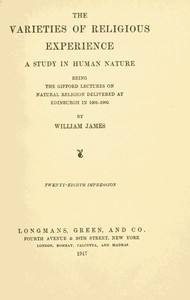
A psychologist examines mysticism, conversion and faith — bridging science and religion.
Why this book matters
The book that invented the psychology of religion — and still hasn't been surpassed a century later.
Read the full Impact essay →
Free Audiobook · Lecture I: Religion and Neurology
0:00 / —
It is with no small amount of trepidation that I take my place behind this desk, and face this learned audience. To us Americans, the experience of receiving instruction from the living voice, as well as from the books, of European scholars, is very familiar…
💬 Books4Free AI Study Assistant
YOU
Why does The Varieties of Religious Experience matter?
AI
The book that invented the psychology of religion — and still hasn't been surpassed a century later.
Read or Listen to The Varieties of Religious Experience on Books4Free
Every chapter free to read. Free audio narration on the opening chapter. Plus an AI study assistant that knows the book.
Open in Books4Free →Character Guide
Spoiler-free — fuller detail (with spoilers, if you want them) lives in the reader's Guide tab.
- William James (the Lecturer)
- The author-narrator, a psychologist and philosopher who delivers these Gifford Lectures, examining personal religious experience empirically rather than theologically.
- Stephen H. Bradley
- An 'unlettered man' whose layered conversion experience—first at fourteen, then again years later—is offered as a case study of sudden religious change.
- S. H. Hadley
- A reformed drunkard whose dramatic conversion and subsequent work rescuing other alcoholics in New York is presented as an example of release from the sense of sin.
- Jonathan Edwards
- The Puritan theologian whose 'Treatise on Religious Affections' is used as a rich, detailed description of supposedly supernatural conversion.
- Saint Teresa of Ávila (Saint Teresa)
- A Spanish mystic referenced for her vivid autobiographical accounts of ecstatic states and their transformative emotional effects.
- Saint John of the Cross
- A mystic quoted on the enriching 'touches' of God upon the soul during contemplative states.
- Saint Ignatius (of Loyola)
- Described as a mystic whose visionary experiences coexisted with, and fueled, immense practical and organizational energy.
- Margaret Mary Alacoque
- A French visionary nun cited as an example of a mystic whose ecstatic absorption left her helplessly impractical in daily life.
- Jouffroy
- A French philosopher whose eloquent account of losing his religious faith is used as an example of 'counter-conversion,' the mirror image of religious conversion.
- Catherine of Siena
- Referenced as an example of the saintly temperament's capacity for fierce partisan zeal, even proposing violence in the name of unifying believers.
- An anonymous convert's daughter (the writer's daughter account)
- An unnamed woman, daughter of a writer against Christianity, whose sudden and joyous sense of God's presence is quoted at length as an example of instantaneous, unforced faith.
Glossary
- Healthy-mindedness
- James's term for a religious temperament that focuses on goodness and happiness while minimizing or ignoring the reality of evil and sin.
- Sick soul
- The opposite temperament to healthy-mindedness: one for whom evil and suffering are essential, inescapable elements of existence that must be confronted.
- Once-born / Twice-born
- James's categories for, respectively, people whose religious life is simple and untroubled, versus those who must undergo a crisis of despair and rebirth to find peace.
- Subliminal self
- James's psychological concept of a region of consciousness below ordinary awareness from which sudden religious experiences, visions, and conversions may erupt.
- Mystical states (the four marks)
- James's proposed criteria (ineffability, noetic quality, transiency, passivity) for classifying an experience as genuinely 'mystical.'
- Orison
- An archaic term for prayer or contemplative devotion, especially the wordless contemplation prized by mystics.
- Theopathic
- A term James coins for an excessive, all-consuming devotional love of God that crowds out ordinary human relationships and interests.
- Sanctification
- The theological term for the state of holiness or moral transformation said to follow a genuine religious conversion.
- Aseity
- A scholastic theological term meaning self-existence or self-derived being, one of God's traditional metaphysical attributes that James questions as practically meaningless.
- Over-belief
- James's term for the personal, non-provable interpretive framework (theological or philosophical) that individuals add on top of raw religious experience.
- Pragmatism
- The philosophical method, credited to Peirce, of judging the meaning of an idea by its practical consequences—used by James to evaluate religious doctrines.
- Counter-conversion
- Term (via Starbuck) for the mirror process of losing religious faith, structurally similar to gaining it.
Table of contents
- Lecture I: Religion and NeurologyFree
- Lecture II: Circumscription of the TopicFree
- Lecture III: The Reality of the UnseenFree
- Lectures IV and V: The Religion of Healthy-MindednessFree
- Lectures VI and VII: The Sick SoulFree
- Lecture VIII: The Divided Self, and the Process of Its UnificationFree
- Lecture IX: ConversionFree
- Lecture X: Conversion—ConcludedFree
- Lectures XI, XII, and XIII: SaintlinessFree
- Lectures XIV and XV: The Value of SaintlinessFree
- Lectures XVI and XVII: MysticismFree
- Lecture XVIII: PhilosophyFree
- Lecture XIX: Other CharacteristicsFree
- Lecture XX: ConclusionsFree
- PostscriptFree
Every chapter is free to read. Premium unlocks the full audiobook.