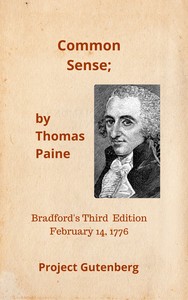
The pamphlet that sparked the American Revolution — plain language for independence.
Why this book matters
The 47-page pamphlet that talked a continent into revolution — Thomas Paine's Common Sense remains one of the most consequential pieces of political writing in history.
Read the full Impact essay →
Free Audiobook · Of the Origin and Design of Government in...
0:00 / —
Of the Origin and Design of Government in general, with concise Remarks on the English Constitution. Of Monarchy and Hereditary Succession Thoughts on the present State of American Affairs Of the present Ability of America, with some miscellaneous Reflections…
💬 Books4Free AI Study Assistant
YOU
Why does Common Sense matter?
AI
The 47-page pamphlet that talked a continent into revolution — Thomas Paine's Common Sense remains one of the most consequential pieces of political writing in history.
Read or Listen to Common Sense on Books4Free
Every chapter free to read. Free audio narration on the opening chapter. Plus an AI study assistant that knows the book.
Open in Books4Free →Character Guide
Spoiler-free — fuller detail (with spoilers, if you want them) lives in the reader's Guide tab.
- The Author (Thomas Paine) (An Englishman)
- The unnamed persuasive voice of the pamphlet, writing as a plain-spoken advocate of American independence who insists he offers only 'simple facts, plain arguments, and common sense.'
- The King of England (George III / 'the Royal Brute of Britain')
- The reigning British monarch, presented early on as the personification of hereditary monarchy's flaws and the immediate cause of America's grievances.
- The English Constitution (as a figure of critique) (King, Lords, and Commons)
- Personified as a flawed three-part system — a hereditary king, a hereditary peerage, and an elected Commons — that Paine dissects as internally contradictory.
- The People Called Quakers (The Society of Friends)
- A religious community whose published political 'Testimony' urging loyalty to Britain is addressed directly and challenged in the appendix.
- America / 'the Continent' (The Colonies)
- Treated almost as a character in its own right — young, united by shared suffering, and standing at a unique historical moment to form its own government.
- William the Conqueror
- Invoked as the historical founder of English kingship, cited to show that English monarchy began in usurpation and conquest rather than divine right.
- Gideon
- A biblical judge of Israel referenced as an example of a leader who refused hereditary kingship, used by Paine to argue that scripture itself opposes monarchy.
Glossary
- Common Sense (as method)
- Paine's rhetorical approach of plain reasoning and everyday language rather than legal jargon or classical theory, meant to make political argument accessible to ordinary readers.
- Hereditary succession
- The practice of passing political power down through a family line regardless of merit; Paine treats this as one of monarchy's central injustices.
- Continental Charter
- Paine's proposed founding document/constitution for a unified American government, to be created deliberately rather than left to chance.
- Quit-rents
- A small annual land tax paid to a landlord or crown; Paine proposes using proceeds from land sales and quit-rents to pay down public debt.
- Felo de se
- Latin legal term for 'self-destruction' or suicide (of a person or, here, a system); Paine uses it to describe the English constitution's self-defeating design.
- Massanello
- Reference to Masaniello, a 17th-century Neapolitan fisherman who led a popular revolt; used by Paine as a warning example of a demagogue who might seize power amid unrest.
- Dragonetti
- Giacinto Dragonetti, an Italian Enlightenment writer on government and virtue, quoted by Paine on the proper aim of political science.
- The Testimony
- A published political statement by Quaker leaders urging loyalty to Britain and non-involvement in rebellion, which Paine directly rebuts in the Appendix.
- Associators
- Pennsylvania militia volunteers ('Associators') whose petition to the colonial Assembly Paine cites as an example of unequal representation.
- 'The Rubicon is passed'
- An allusion to Julius Caesar's irreversible crossing of the Rubicon River, used by Paine to declare that reconciliation with Britain is no longer possible.
- Sequestered state of natural liberty
- Paine's hypothetical starting condition of a small isolated society with no government, used as a thought experiment to derive the true purpose of government.
Table of contents
- Of the Origin and Design of Government in...Free
- Of The Origin And Design Of Government In...Free
- OF MONARCHY AND HEREDITARY SUCCESSION.: Mankind...Free
- THOUGHTS ON THE PRESENT STATE OF AMERICAN...Free
- Of The Present Ability Of America,: With Some...Free
- APPENDIX.: Since the publication of the first...Free
Every chapter is free to read. Premium unlocks the full audiobook.