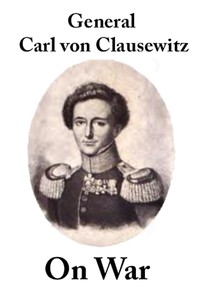
War is the continuation of politics — the definitive treatise on military strategy.
Why this book matters
The book that taught generals, presidents, and revolutionaries how to think about war — and still hasn't been surpassed.
Read the full Impact essay →
Free Audiobook · Book One: What is War?
0:00 / —
CHAPTER I. What is War? 1. INTRODUCTION. We propose to consider first the single elements of our subject, then each branch or part, and, last of all, the whole, in all its relations—therefore to advance from the simple to the complex. But it is necessary for…
💬 Books4Free AI Study Assistant
YOU
Why does On War matter?
AI
The book that taught generals, presidents, and revolutionaries how to think about war — and still hasn't been surpassed.
Read or Listen to On War on Books4Free
Every chapter free to read. Free audio narration on the opening chapter. Plus an AI study assistant that knows the book.
Open in Books4Free →Character Guide
Spoiler-free — fuller detail (with spoilers, if you want them) lives in the reader's Guide tab.
- Carl von Clausewitz (The Author)
- A Prussian general and military theorist who writes as the analytical voice of the work, developing a systematic theory of war from first principles.
- Napoleon Bonaparte (Buonaparte)
- Referenced repeatedly as the preeminent modern practitioner of war, whose campaigns (e.g., the invasion of Russia) serve as key illustrative examples of decisive, 'absolute' warfare.
- Frederick the Great
- The Prussian king whose Seven Years' War campaigns are cited early as examples of strategic manoeuvring, economy of force, and the use of artillery by a weaker state.
- The Defender
- A recurring theoretical figure (not a historical person) representing the army or commander conducting a defensive campaign, whose choices and dilemmas structure much of the book's analysis.
- The Assailant (The Aggressor)
- The theoretical counterpart to the Defender, representing the offensive side in battle and strategy, whose advantages and risks are analyzed throughout.
Glossary
- Absolute war
- Clausewitz's concept of war pursued to its theoretical extreme, with maximum force and decision-seeking, unmoderated by political restraint.
- Centre of gravity
- The idea that an enemy's power should be concentrated conceptually into as few 'points' as possible so a decisive blow can be aimed at it.
- Economy of force
- The principle that no more strength than necessary should be dedicated to secondary objects, so as to preserve force for the decisive point.
- Friction
- Clausewitz's term for the countless small, unpredictable difficulties (fatigue, error, chance) that make even simple military plans hard to execute in practice.
- Culminating point
- The moment at which an attacking force's superiority is exhausted and it risks tipping into weakness relative to the defender.
- Landsturm
- A general levy or mass militia of the population called up for national defense, as opposed to a professional standing army.
- Theatre of war
- The overall geographic and strategic area in which a campaign's armies, fortresses, and lines of communication operate.
- Successive resistance
- A (criticized) method of defense that relies on a gradual, staggered application of force over time rather than concentrating it all at once.
- Strategic reserve
- Forces held back from initial combat to be committed later, used to secure or exploit the final decision of a campaign.
- Tension and rest (dynamic law of war)
- Clausewitz's model describing war as alternating between periods of active striving toward a decision ('tension') and pauses of equilibrium ('rest').
Table of contents
- Book One: What is War?Free
- Ends and Means in WarFree
- The Genius for WarFree
- Of Danger in WarFree
- Of Bodily Exertion in WarFree
- Information in WarFree
- Friction in WarFree
- Concluding RemarksFree
- Book Two: Branches of the Art of WarFree
- On the Theory of WarFree
- Art or Science of WarFree
- MethodicismFree
- CriticismFree
- On ExamplesFree
- Book Three: StrategyFree
- Elements of StrategyFree
- Moral ForcesFree
- The Chief Moral PowersFree
- Military Virtue of an ArmyFree
- BoldnessFree
- PerseveranceFree
- Superiority of NumbersFree
- The SurpriseFree
- chapter in the Art of War, to invest a strong place unexpectedly, butFree
- StratagemFree
- Assembly of Forces in SpaceFree
- Assembly of Forces in TimeFree
- Strategic ReserveFree
- Economy of ForcesFree
- Geometrical ElementFree
- On the Suspension of the Act in WarFree
- On the Character of Modern WarFree
- Tension and RestFree
- Book Four: IntroductoryFree
- Character of a Modern BattleFree
- The Combat in GeneralFree
- The Combat in General (_continuation_)Free
- On the Signification of the CombatFree
- Duration of CombatFree
- Decision of the CombatFree
- Mutual Understanding as to a BattleFree
- The Battle(*)Free
- Effects of VictoryFree
- The Use of the BattleFree
- Strategic Means of Utilising VictoryFree
- Retreat After a Lost BattleFree
- Night FightingFree
- Book Five: General SchemeFree
- Theatre of War, Army, CampaignFree
- Relation of PowerFree
- Relation of the Three ArmsFree
- Order of Battle of an ArmyFree
- General Disposition of an ArmyFree
- Advanced Guard and Out-PostsFree
- Mode of Action of Advanced CorpsFree
- CampsFree
- MarchesFree
- Marches (_Continued_)Free
- Marches (_continued_)Free
- CantonmentsFree
- SubsistenceFree
- Base of OperationsFree
- Lines of CommunicationFree
- On Country and GroundFree
- Command of GroundFree
- Book Six: Offence and DefenceFree
- The Relations of the Offensive and Defensive to Each OtherFree
- Book Six: Chapter IIIFree
- Convergence of Attack and Divergence of DefenceFree
- Character of the Strategic DefensiveFree
- Extent of the Means of DefenceFree
- Mutual Action and Reaction of Attack and DefenceFree
- Methods of ResistanceFree
- Defensive BattleFree
- FortressesFree
- Fortresses (_Continued_)Free
- Defensive PositionFree
- Strong Positions and Entrenched CampsFree
- Flank PositionsFree
- Defence of MountainsFree
- Defence of Mountains (_Continued_)Free
- Defence of Mountains (_continued_)Free
- Defence of Streams and RiversFree
- Defence of Streams and Rivers (_continued_)Free
- A. Defence of SwampsFree
- Defence of ForestsFree
- The CordonFree
- Key to the CountryFree
- Operating Against a FlankFree
- Retreat into the Interior of the CountryFree
- Arming the NationFree
- Defence of a Theatre of WarFree
- Defence of a Theatre of War—(_continued_)Free
- Defence of a Theatre of War (_continued_) SuccessiveFree
- Book Six: Chapter XXXFree
- Book Seven: The Attack in Relation to the DefenceFree
- Nature of the Strategical AttackFree
- Of the Objects of Strategical AttackFree
- Decreasing Force of the AttackFree
- Culminating Point of the AttackFree
- Destruction of the Enemy’s ArmiesFree
- The Offensive BattleFree
- Passage of RiversFree
- Attack on Defensive PositionsFree
- Attack on an Entrenched CampFree
- Attack on a MountainFree
- Attack on Cordon LinesFree
- ManœuvringFree
- Attack on Morasses, Inundations, WoodsFree
- Attack on a Theatre of War with the View to a DecisionFree
- Attack on a Theatre of War without the View to a GreatFree
- Attack on FortressesFree
- Attack on ConvoysFree
- Attack on the Enemy’s Army in its CantonmentsFree
- DiversionFree
- InvasionFree
- On the Culminating Point of Victory(*)Free
- Book Eight: IntroductionFree
- Absolute and Real WarFree
- A. Interdependence of the Parts in WarFree
- Ends in War More Precisely DefinedFree
- Ends in War More Precisely Defined (_continued_) LimitedFree
- Book Eight: Chapter VIFree
- Limited Object—Offensive WarFree
- Limited Object—DefenceFree
- Book Eight: Chapter IXFree
Every chapter is free to read. Premium unlocks the full audiobook.