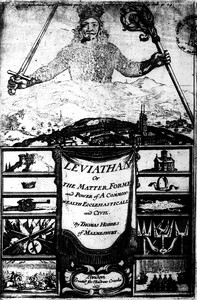
The social contract and the case for strong government — foundational political philosophy.
Why this book matters
Written during civil war and banned after publication, Leviathan remains the most unsettling argument for political order ever written.
Read the full Impact essay →
Free Audiobook · Chapter I. Of Sense
0:00 / —
Concerning the Thoughts of man, I will consider them first Singly, and afterwards in Trayne, or dependance upon one another. Singly, they are every one a Representation or Apparence, of some quality, or other Accident of a body without us; which is commonly…
💬 Books4Free AI Study Assistant
YOU
Why does Leviathan matter?
AI
Written during civil war and banned after publication, Leviathan remains the most unsettling argument for political order ever written.
Read or Listen to Leviathan on Books4Free
Every chapter free to read. Free audio narration on the opening chapter. Plus an AI study assistant that knows the book.
Open in Books4Free →Character Guide
Spoiler-free — fuller detail (with spoilers, if you want them) lives in the reader's Guide tab.
- Leviathan (The Commonwealth, the 'Mortall God')
- The artificial man created when individuals covenant together and authorize a single sovereign will to represent them all, described in the opening chapters as a giant body politic built to end the chaos of the state of nature.
- The Sovereign (The Soveraign Representative)
- Whoever (a single man or an assembly) is authorized by the covenant of the people to hold absolute, indivisible power over legislation, judicature, war and peace, and the censorship of doctrines.
- Natural Man (Man in the State of Nature)
- Hobbes's picture of a human being before or without government, possessing an unlimited natural right to all things and living in constant fear amid a 'war of every man against every man.'
- The Subject
- Any person who has given up their natural right of self-governance to the sovereign in exchange for protection, owing simple obedience except where it would conflict with divine law.
- The Fool
- A rhetorical figure introduced early on who says in his heart there is no such thing as justice, used by Hobbes as a foil to argue why keeping covenants is rational.
- God, King by Nature (The Kingdome of God)
- In Hobbes's framework, the deity who reigns over all rational subjects through natural precepts, rewards, and punishments, distinct from any earthly kingdom of God established by covenant.
- Cardinal Bellarmine
- A real Catholic theologian whose arguments for papal supremacy over civil rulers are introduced as the strongest version of a rival position that Hobbes intends to examine and answer.
Glossary
- Jus Naturale (Right of Nature)
- The liberty each person has to use their own power as they judge best for self-preservation.
- Lex Naturalis (Law of Nature)
- A rational precept forbidding actions destructive to one's own life, distinguished by Hobbes from mere 'right' (liberty) as an actual binding rule.
- Mortall God
- Hobbes's term for the sovereign/commonwealth, an artificial, man-made power that keeps peace the way the eternal God rules the universe.
- War of every man against every man
- Hobbes's description of the state of nature, a condition of constant mutual threat, not necessarily open fighting but a standing readiness for it.
- Reckoning
- Hobbes's definition of reason itself, as a mental process of 'adding and subtracting' the logical consequences of general names or terms.
- Nosce teipsum
- Latin for 'know thyself,' Hobbes's methodological advice that readers can learn about human passions in general by examining their own minds.
- Pleonexia
- A Greek term Hobbes uses for the vice of arrogance—demanding for oneself rights or advantages one would not grant to others.
- Prosopolepsia (Acception of Persons)
- Partiality or favoritism in judgment, the violation of the natural law of equity between disputing parties.
- Decaying sense
- Hobbes's materialist definition of imagination, describing it as the fading residue of sensory impressions after the original stimulus is gone.
- Jus vs. Lex (Right vs. Law)
- Hobbes's careful distinction between 'right' as liberty to act or not act, and 'law' as an obligation binding one to a specific course, which he says are often wrongly conflated.
Table of contents
- Chapter I. Of SenseFree
- Chapter II. Of ImaginationFree
- Chapter III. Of The Consequence Or Trayne Of ImaginationsFree
- Chapter IV. Of SpeechFree
- Chapter V. Of Reason, And Science.Free
- Chapter VI. Of The Interiour Beginnings Of Voluntary MotionsFree
- Chapter VII. Of The Ends Or Resolutions Of DiscourseFree
- Chapter VIII. Of The Vertues Commonly Called Intellectual; And TheirFree
- Chapter IX. Of The Severall Subjects Of KnowledgeFree
- Chapter X. Of Power, Worth, Dignity, Honour And WorthinessFree
- Chapter XI. Of The Difference Of MannersFree
- Chapter XII. Of ReligionFree
- Chapter XIII. Of The Naturall Condition Of Mankind,Free
- Chapter XIV. Of The First And Second Naturall Lawes, And Of ContractsFree
- Chapter XV. Of Other Lawes Of NatureFree
- Chapter XVI. Of Persons, Authors, And Things PersonatedFree
- Chapter XVII. Of The Causes, Generation, And Definition Of AFree
- Chapter XVIII. Of The Rights Of Soveraignes By InstitutionFree
- Chapter XIX. Of The Severall Kinds Of Common-wealth By Institution,Free
- Chapter XX. Of Dominion Paternall And DespoticallFree
- Chapter XXI. Of The Liberty Of SubjectsFree
- Chapter XXII. Of Systemes Subject, Politicall, And PrivateFree
- Chapter XXIII. Of The Publique Ministers Of Soveraign PowerFree
- Chapter XXIV. Of The Nutrition, And Procreation Of A Common-wealthFree
- Chapter XXV. Of CounsellFree
- Chapter XXVI. Of CIVILL LawesFree
- Chapter XXVII. Of Crimes, Excuses, And ExtenuationsFree
- Chapter XXVIII. Of Punishments, And RewardsFree
- Chapter XXIXFree
- Chapter XXX. Of The Office Of The Soveraign RepresentativeFree
- Chapter XXXI. Of The Kingdome Of God By NatureFree
- Chapter XXXII. Of The Principles Of Christian PolitiquesFree
- Chapter XXXIII. Of The Number, Antiquity, Scope, Authority, AndFree
- Chapter XXXIVFree
- Chapter XXXV. Of The Signification In Scripture Of Kingdome Of God, OfFree
- Chapter XXXVI. Of The Word Of God, And Of ProphetsFree
- Chapter XXXVII. Of Miracles, And Their UseFree
- Chapter XXXVIII. Of The Signification In Scripture Of Eternall Life,Free
- Chapter XXXIX. Of The Signification In Scripture Of The Word ChurchFree
- Chapter XL Of The Rights Of The Kingdome Of God, In Abraham, Moses,Free
- Chapter XLI. Of The Office Of Our Blessed SaviourFree
- Chapter XLII. Of Power EcclesiasticallFree
- Chapter XLIII. Of What Is Necessary For A Mans Reception Into TheFree
- Chapter XLIV. Of Spirituall Darknesse From Misinterpretation OfFree
- Chapter XLV. Of Daemonology, And Other Reliques Of The Religion Of TheFree
- Chapter XLVIFree
- Chapter XLVII. Of The Benefit That Proceedeth From Such Darknesse, AndFree
Every chapter is free to read. Premium unlocks the full audiobook.