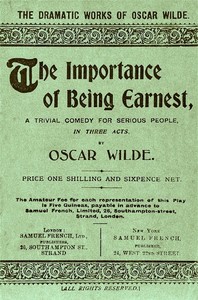
Oscar Wilde's wittiest comedy — mistaken identities and trivial matters.
Why this book matters
The funniest play in the English language, written by a man who had no idea his world was about to collapse.
Read the full Impact essay →
Free Audiobook · ACT I. Algernon Moncrieff’s Flat in Half-Moon Street, W.
0:00 / —
ACT II. The Garden at the Manor House, Woolton. ACT III. Drawing-Room at the Manor House, Woolton. TIME: The Present. LONDON: ST. JAMES’S THEATRE Lessee and Manager: Mr. George Alexander February 14th, 1895 * * * * * John Worthing, J.P.: Mr. George Alexander…
💬 Books4Free AI Study Assistant
YOU
Why does The Importance of Being Earnest matter?
AI
The funniest play in the English language, written by a man who had no idea his world was about to collapse.
Read or Listen to The Importance of Being Earnest on Books4Free
Every chapter free to read. Free audio narration on the opening chapter. Plus an AI study assistant that knows the book.
Open in Books4Free →Character Guide
Spoiler-free — fuller detail (with spoilers, if you want them) lives in the reader's Guide tab.
- Jack Worthing (Ernest (in town))
- A respectable country gentleman and guardian to Cecily Cardew, who maintains a fictitious wicked younger brother named Ernest as an excuse to visit London.
- Algernon Moncrieff
- Jack's witty, idle friend who invents a permanent invalid named Bunbury as an excuse to escape social obligations and visit the country.
- Gwendolen Fairfax
- Algernon's sophisticated cousin and Lady Bracknell's daughter, who is fixed on the idea of loving a man named Ernest.
- Cecily Cardew
- Jack's pretty and imaginative eighteen-year-old ward, who lives in the country under Miss Prism's tutelage and dreams of Jack's fictional brother Ernest.
- Lady Bracknell
- Gwendolen's formidable, socially exacting mother who interrogates suitors about their eligibility, fortune, and family origins.
- Miss Prism
- Cecily's prim governess, who lectures her charge on serious subjects like German and geology while harboring a mysterious past.
- Dr. Chasuble (The Rector)
- The local clergyman with an interest in christenings, who becomes entangled with Miss Prism.
- Lane
- Algernon's imperturbable manservant in London, who offers dry commentary on domestic matters.
- Merriman
- The butler at Jack's country house, who announces guests and manages household affairs.
Glossary
- Bunburying
- Algernon's invented practice of using a fictitious invalid friend named Bunbury as an excuse to escape social duties; it becomes shorthand in the play for maintaining a convenient double life.
- Bunburyist
- A person who practices Bunburying — i.e., someone who invents excuses or alter egos to escape obligations.
- the Albany
- A fashionable set of bachelor apartments in London where Jack claims his fictitious brother Ernest resides.
- dog-cart
- A light, horse-drawn two-wheeled carriage, used here for travel between the country house and the train station.
- basinette
- An old spelling of 'bassinet,' a wicker basket used as a baby's bed, mistakenly swapped with a handbag in Miss Prism's backstory.
- Terminus
- A railway station's end point; Lady Bracknell uses the word mockingly to question whether Cecily's family originated from a train station, referencing Jack's own origin.
- University Extension Scheme
- A real Victorian program offering public lectures on academic subjects; invoked as a cover story for Gwendolen's whereabouts.
- muffins vs. tea-cake
- Victorian afternoon tea foods distinguished with comic seriousness by Algernon, symbolizing the play's mockery of trivial matters treated with gravity.
- Gorgon
- A monstrous female figure from Greek mythology; Jack uses it as an insult for the intimidating Lady Bracknell.
Table of contents
Every chapter is free to read. Premium unlocks the full audiobook.