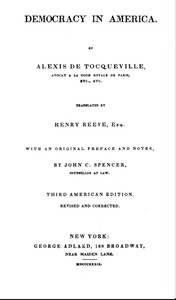
A Frenchman examines American democracy — still the most insightful book about the United States.
Why this book matters
A 29-year-old Frenchman spent nine months in America and wrote the book that still explains the country better than most Americans can.
Read the full Impact essay →
Free Audiobook · Chapter I: Exterior Form Of North America
0:00 / —
Chapter Summary North America divided into two vast regions, one inclining towards the Pole, the other towards the Equator—Valley of the Mississippi—Traces of the Revolutions of the Globe—Shore of the Atlantic Ocean where the English Colonies were…
💬 Books4Free AI Study Assistant
YOU
Why does Democracy in America matter?
AI
A 29-year-old Frenchman spent nine months in America and wrote the book that still explains the country better than most Americans can.
Read or Listen to Democracy in America on Books4Free
Every chapter free to read. Free audio narration on the opening chapter. Plus an AI study assistant that knows the book.
Open in Books4Free →Character Guide
Spoiler-free — fuller detail (with spoilers, if you want them) lives in the reader's Guide tab.
- Alexis de Tocqueville (The Author/Narrator)
- A French aristocrat and magistrate who travels through the United States in the early 1830s to study its prisons and, more broadly, its democratic institutions and social condition.
- The Anglo-Americans (Americans)
- The English-descended settlers and their descendants who colonized British America, established under conditions of remarkable social equality from the outset.
- The Puritans of New England
- The earliest emigrants to New England, described as having brought a democratic and republican form of Christianity that shaped the young nation's laws and habits.
- The Sovereign Majority (The Majority)
- Not a person but the collective political force in American democracy, described as holding 'a prodigious actual authority, and a moral influence which is scarcely less preponderant.'
- Southern Landed Proprietors
- Large-scale planters in the South-West of the Hudson who imported English aristocratic principles and the law of descent, forming a quasi-aristocratic class without formal privileges.
- The American Clergy
- Religious leaders described as broadly favoring civil freedom while staying deliberately aloof from party politics and public affairs.
- Native American Tribes (Indians (e.g., Cherokees, Creeks))
- Southern nations gradually enclosed within shrinking territory by advancing European settlement, some of whom took up agriculture out of necessity.
- American Public Officials and Judges
- Magistrates and elected functionaries whose independence and conduct are examined as part of the machinery of political jurisdiction and administration.
Glossary
- Social condition (état social)
- Tocqueville's term for the overall equality or inequality of circumstances, wealth, and status in a society, which he treats as the root cause shaping a nation's laws and customs.
- Manners (moeurs)
- A broad term Tocqueville uses for the moral, intellectual, and habitual characteristics of a people collectively—more influential, he argues, than laws or geography in sustaining democracy.
- Tyranny of the majority
- Tocqueville's famous concept describing how, in a democracy, the unlimited power of the majority can suppress minority rights and opinions without needing physical force.
- Township (New England town)
- The small local self-governing unit Tocqueville sees as the foundational school of American democratic participation and civic habit.
- Political jurisdiction
- The American practice (impeachment) of using political trials mainly to remove officials from power rather than to inflict criminal punishment, contrasted with harsher European political trials.
- Aristocracy (as used by Tocqueville)
- A social order based on permanent, hereditary, legally unequal ranks—explicitly contrasted throughout the book with America's democratic social condition.
- Anglo-Americans
- Tocqueville's standard term for the English-descended inhabitants of the United States, as distinct from other New World populations like the Spanish colonists.
- Equality of conditions
- The pervasive social leveling—of wealth, status, and opportunity—that Tocqueville identifies as the defining, unstoppable feature of the modern (and specifically American) age.
Table of contents
- Chapter I: Exterior Form Of North AmericaFree
- Chapter II: Origin Of The Anglo-Americans—Part IFree
- Chapter III: Origin Of The Anglo-Americans—Part IIFree
- Chapter IV: Social Conditions Of The Anglo-AmericansFree
- Chapter V: The Principle Of The Sovereignty Of The People In AmericaFree
- Chapter VI: Necessity Of Examining The Condition Of The States—Part IFree
- Chapter VII: Necessity Of Examining The Condition Of The States—Part IIFree
- Chapter VIII: Necessity Of Examining The Condition Of The States—Part IIIFree
- Chapter IX: Judicial Power In The United StatesFree
- Chapter X: Political Jurisdiction In The United StatesFree
- Chapter XI: The Federal Constitution—Part IFree
- Chapter XII: The Federal Constitution—Part IIFree
- Chapter XIII: The Federal Constitution—Part IIIFree
- Chapter XIV: The Federal Constitution—Part IVFree
- Chapter XV: The Federal Constitution—Part VFree
- Chapter XVI: Why The People May Strictly Be Said To Govern In TheFree
- Chapter XVII: Parties In The United StatesFree
- Chapter XVIII: Liberty Of The Press In The United StatesFree
- Chapter XIX: Political Associations In The United StatesFree
- Chapter XX: Government Of The Democracy In America—Part IFree
- Chapter XXI: Government Of The Democracy In America—Part IIFree
- Chapter XXII: Government Of The Democracy In America—Part IIIFree
- Chapter XXIII: Advantages American Society Derive From Democracy—Part IFree
- Chapter XXIV: Advantages American Society Derive From Democracy—Part IIFree
- Chapter XXV: Unlimited Power Of Majority, And Its Consequences—Part IFree
- Chapter XXVI: Unlimited Power Of Majority, And Its Consequences—Part IIFree
- Chapter XXVII: Causes Mitigating Tyranny In The United States—Part IFree
- Chapter XXVIII: Causes Mitigating Tyranny In The United States—Part IIFree
- Chapter XVII: Principal Causes Maintaining The DemocraticFree
- Chapter XVII: Principal Causes Maintaining The DemocraticFree
- Chapter XVII: Principal Causes Maintaining The DemocraticFree
- Chapter XVII: Principal Causes Maintaining The DemocraticFree
- Chapter XXXIII: Future Condition Of Three Races In The UnitedFree
- Chapter XXXIV: Future Condition Of Three Races—Part IIFree
- Chapter XXXV: Future Condition Of Three Races—Part IIIFree
- Chapter XXXVI: Future Condition Of Three Races—Part IVFree
- Chapter XXXVII: Future Condition Of Three Races—Part VFree
- Chapter XXXVIII: Future Condition Of Three Races—Part VIFree
- Chapter XXXIX: Future Condition Of Three Races—Part VIIFree
- Chapter XL: Future Condition Of Three Races—Part VIIIFree
- Chapter XLI: Future Condition Of Three Races—Part IXFree
- Chapter XLII: Future Condition Of Three Races—Part XFree
Every chapter is free to read. Premium unlocks the full audiobook.
Popular passages
- Tyranny of the Majority
- Soft Despotism / Democratic Despotism
- Individualism and Withdrawal from Public Life
- Voluntary Associations and Civil Society
- Equality of Conditions as the Generative Fact
- Self-Interest Rightly Understood
- Religion as Political Institution
- Township Democracy and Local Self-Government